Safety Stock: How Much Buffer You Actually Need
Safety stock is the buffer that absorbs demand and lead-time swings so you don't stock out. Learn what it is, why you hold it, and the service-level trade-off.
Your supplier slips two days. A promo runs hotter than the forecast said it would. Suddenly the "safe" number on the shelf isn't so safe. Every operator knows that quiet dread of watching a best-seller drain while the next shipment is still somewhere on a truck. Safety stock is the cushion that decides whether that moment is a shrug or a stockout.
Safety stock is the extra inventory you hold to absorb the demand and lead-time swings your forecast can't predict. It's sized by how much stockout risk you'll tolerate and how much your demand and lead time bounce around. Hold too little and you stock out. Hold too much and you tie up cash.
What is safety stock?
Safety stock is a buffer of inventory you keep on hand to cover the swings in demand and supply that happen while you're waiting on a replenishment order. It's not the stock you plan to sell in a normal week. It's the reserve that sits underneath, ready for the week that isn't normal.
Every planner deals with two kinds of stock, and it helps to keep them straight.
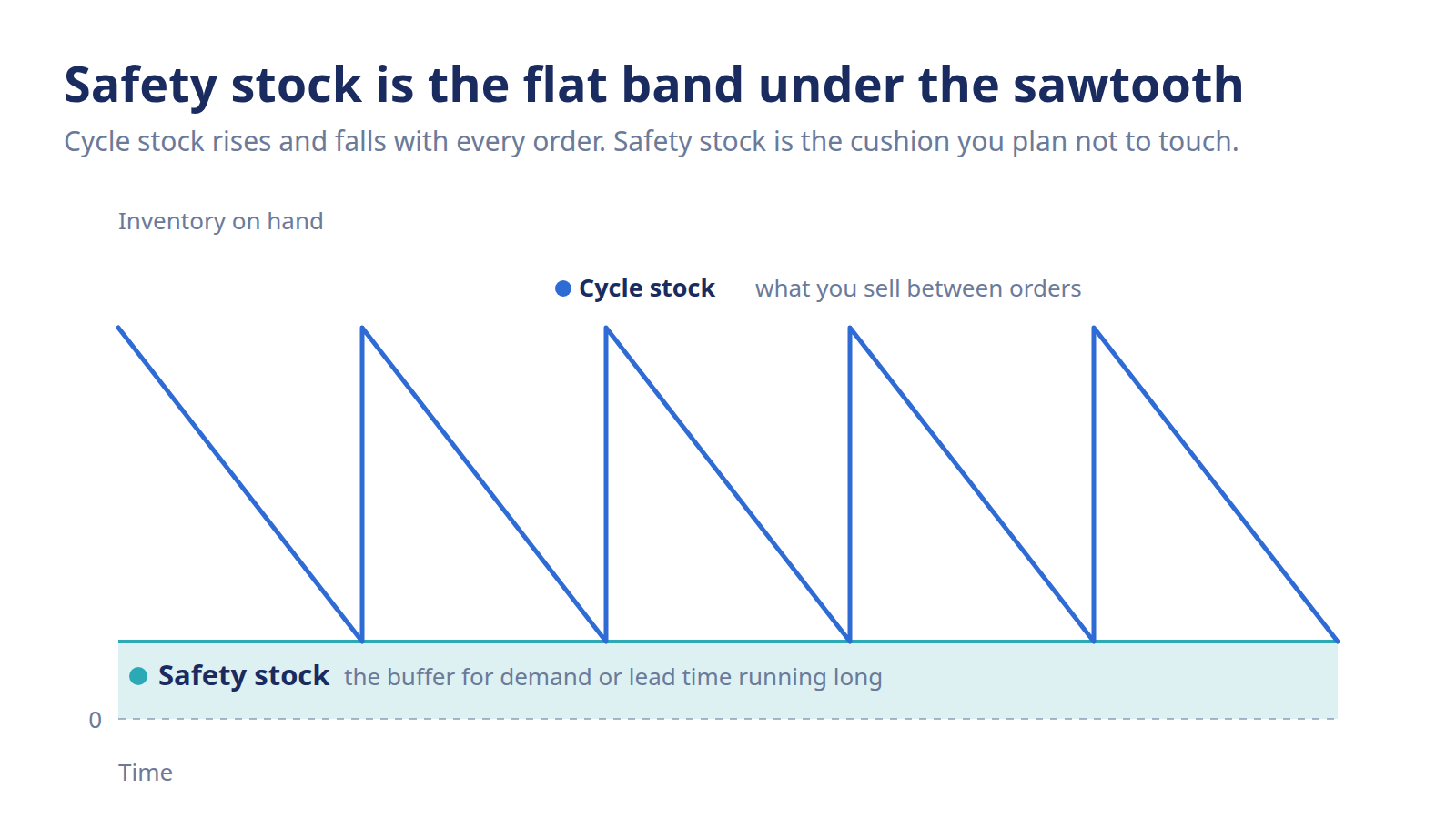
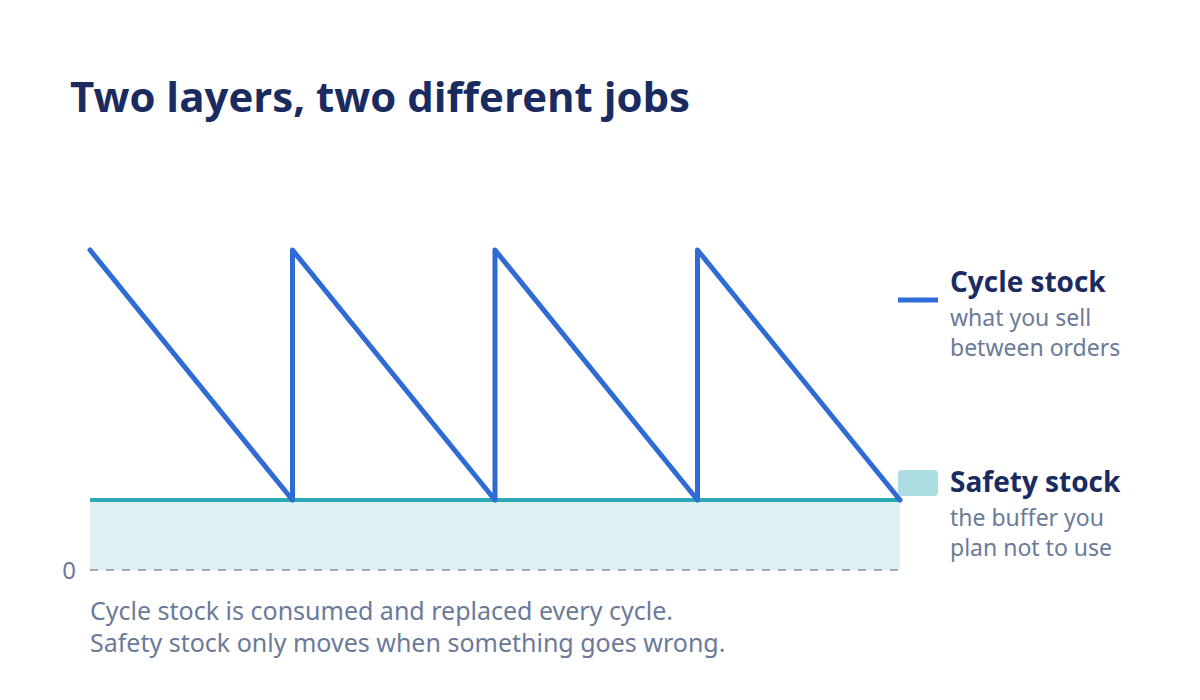
Cycle stock is the working inventory you expect to sell between replenishments. It rises when an order lands and falls as you sell through, that predictable sawtooth on the chart.
Safety stock is the flat cushion beneath the sawtooth. It doesn't move with normal sales. It's there for the spike you didn't see coming or the delivery that showed up late.
Where safety stock sits relative to the reorder point
Safety stock doesn't work alone, it lives inside your reorder point. The reorder point is the stock level that triggers your next purchase order. It's built from two pieces: the demand you'll burn through during the supplier's lead time, plus the safety stock underneath.
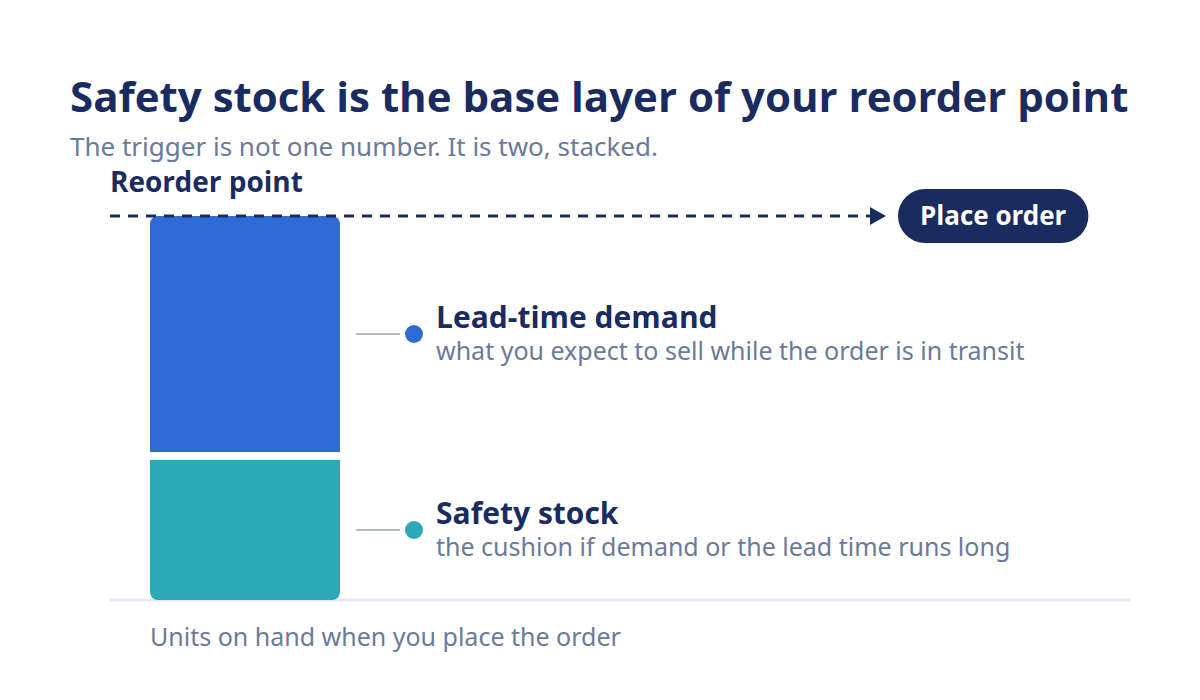
So when on-hand inventory drops to the reorder point, you place an order. The cycle stock above the buffer covers expected demand while the order is in transit. The safety stock covers the part you can't expect. If everything goes to plan, you never touch it. On the weeks things go sideways, it's the reason you don't disappoint a customer.
Why do you hold safety stock?
You hold safety stock because demand and lead time are never as steady as a forecast makes them look, and a stockout usually costs more than the buffer does. It's a risk trade: you carry a little extra inventory to protect against the two things you can't fully control, how fast you'll sell and how long resupply takes.
Cut the buffer to zero and you're betting that every week hits the average and every shipment lands on time. Neither happens for long. Two forces make the buffer necessary.
The two drivers: demand and lead-time variability
Safety stock exists to absorb variability, and it comes from two places.
Demand variability is how much your daily or weekly sales bounce around their average. A steady staple barely moves; a trend item can double one week and stall the next. The more your sales swing, the bigger the buffer you need. That swing is the input, and how you measure it is its own topic, see demand variability.
Lead-time variability is how much your supplier's delivery window drifts. A quoted two weeks that sometimes stretches to four is a hidden buffer-killer, because the longer and less reliable the wait, the more can go wrong before resupply arrives.
Here's the part worth sitting with: safety stock isn't about a lack of planning. It's the mathematically honest answer to the fact that the future is uncertain. Even a great forecast has error, and the buffer is what you hold against that error.
The cost of the buffer
None of this is free. Every unit of safety stock is cash sitting on a shelf, capital you can't spend, space you're paying for, and product that could go stale before it sells. That's inventory carrying cost, and it's the reason you don't just hold a mountain of buffer and call it safe.
The whole game is balance. Enough buffer to protect revenue, not so much that it quietly bleeds margin. Which brings us to the dial that sets the size.
How much safety stock is enough? The service-level trade-off
There's no single right amount of safety stock, it's a business decision, not a technical one. The lever is your service level: the share of the time you're in stock when a customer comes looking. A higher service level buys more protected revenue but ties up more cash; a lower one frees cash but accepts more stockout risk.
That trade-off is the heart of the decision, so it's worth being clear about what's moving.
Service level is the dial you turn
Service level is the target probability that you won't stock out during a replenishment cycle. Set it to 95% and you're saying you'll accept stocking out roughly 5% of the time on that product. Push it to 99% and you're buying near-certainty, at the price of a noticeably larger buffer.
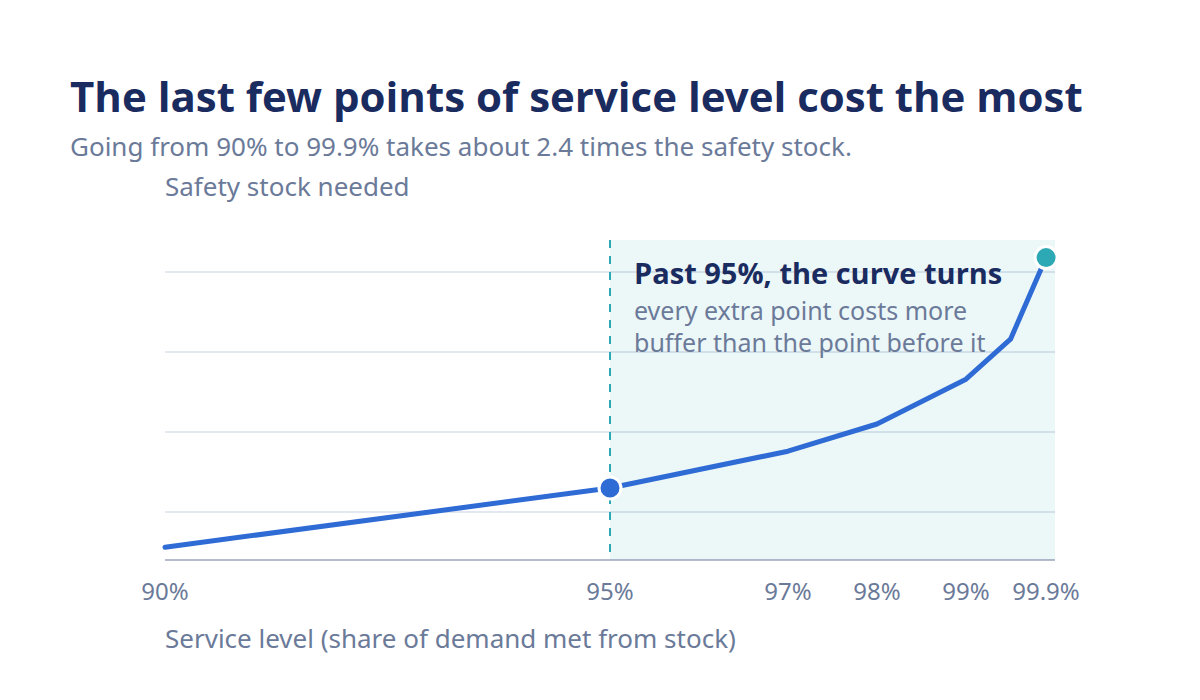
The catch is that the last few points cost the most. Chasing 99% instead of 95% can add a heavy chunk of buffer for a small gain in in-stock probability. That's why a blanket target across your whole catalog quietly wastes cash: your best-sellers may earn the extra protection, but your slow movers rarely do. Service level is deep enough to deserve its own read, see service level and fill rate for how the target and the actual in-stock experience differ.
Where the formula comes in
At some point "how much is enough" stops being a concept and becomes a number, and that's where the math enters. The standard safety stock formula turns your service level, your demand variability, and your lead time into a specific unit count. We're not going to derive it here, this piece is about what safety stock is and why it matters.
For the full walkthrough, follow the safety stock formula step-by-step example. It covers the equation, the Z-score table that converts a service level into a multiplier, and a complete worked example on a real SKU. That's where the buffer stops being an idea and becomes a purchase order.
And once you're setting buffers across hundreds of SKUs, doing it by hand in a spreadsheet stops scaling. Each one has its own demand swing, lead time, and the right service level for its value. AI-powered demand forecasting recalculates those inputs as your sales history updates and adjusts each SKU's buffer instead of leaving you a static number to revisit once a quarter. Conative's inventory planning platform sizes safety stock and reorder points by SKU and flags when a buffer is drifting out of line. Your team spends less time rebuilding formulas and more time acting on the exceptions. Want to see it run on your own catalog? Book a demo.
Frequently asked questions
Is safety stock the same as buffer stock?
In everyday use, yes, most planners treat safety stock and buffer stock as the same thing: extra inventory held to protect against variability. Some teams use "buffer stock" more loosely for any reserve, including stock held for price swings or supply disruption. When people say safety stock, they almost always mean the statistical buffer sized to demand and lead-time uncertainty.
Where does safety stock sit relative to the reorder point?
Safety stock sits inside the reorder point, not beside it. The reorder point is the trigger level that fires a new order, and it's calculated as expected demand during lead time plus safety stock. So the buffer is one ingredient of the reorder point. When on-hand stock hits that level, the safety stock is the cushion still underneath the incoming order.
Does every SKU need safety stock?
Not equally. High-value, fast-moving, or hard-to-forecast SKUs earn a real buffer because a stockout there costs the most. Slow movers and low-margin items often warrant little or none, since the carrying cost outweighs the stockout risk. Segmenting your catalog by value and demand pattern beats applying one blanket buffer rule across everything you sell.
What happens if safety stock is too high?
Too much safety stock ties up cash you could spend elsewhere, fills space you're paying for, and raises the odds that product ages out before it sells. That's carrying cost eating your margin quietly. An oversized buffer feels safe, but it's the most common way brands over-invest in inventory. The goal is enough protection to cover real variability, not to eliminate all risk.
How is safety stock different from cycle stock?
Cycle stock is the working inventory you expect to sell between deliveries, it rises when an order lands and falls as you sell through. Safety stock is the flat reserve beneath it that you hold for the swings you can't predict. Cycle stock is planned consumption; safety stock is protection. Together they set how much you carry between replenishments.
Can AI set safety stock automatically?
Yes. AI-powered demand forecasting can recalculate the demand variability and lead-time inputs behind safety stock continuously, then adjust each SKU's buffer as patterns shift. That replaces a static number you revisit once a quarter with one that stays current. The buffer then reflects this quarter's variability rather than the variability you measured when you first set it.
.png)