
Service Level and Fill Rate in Inventory Planning
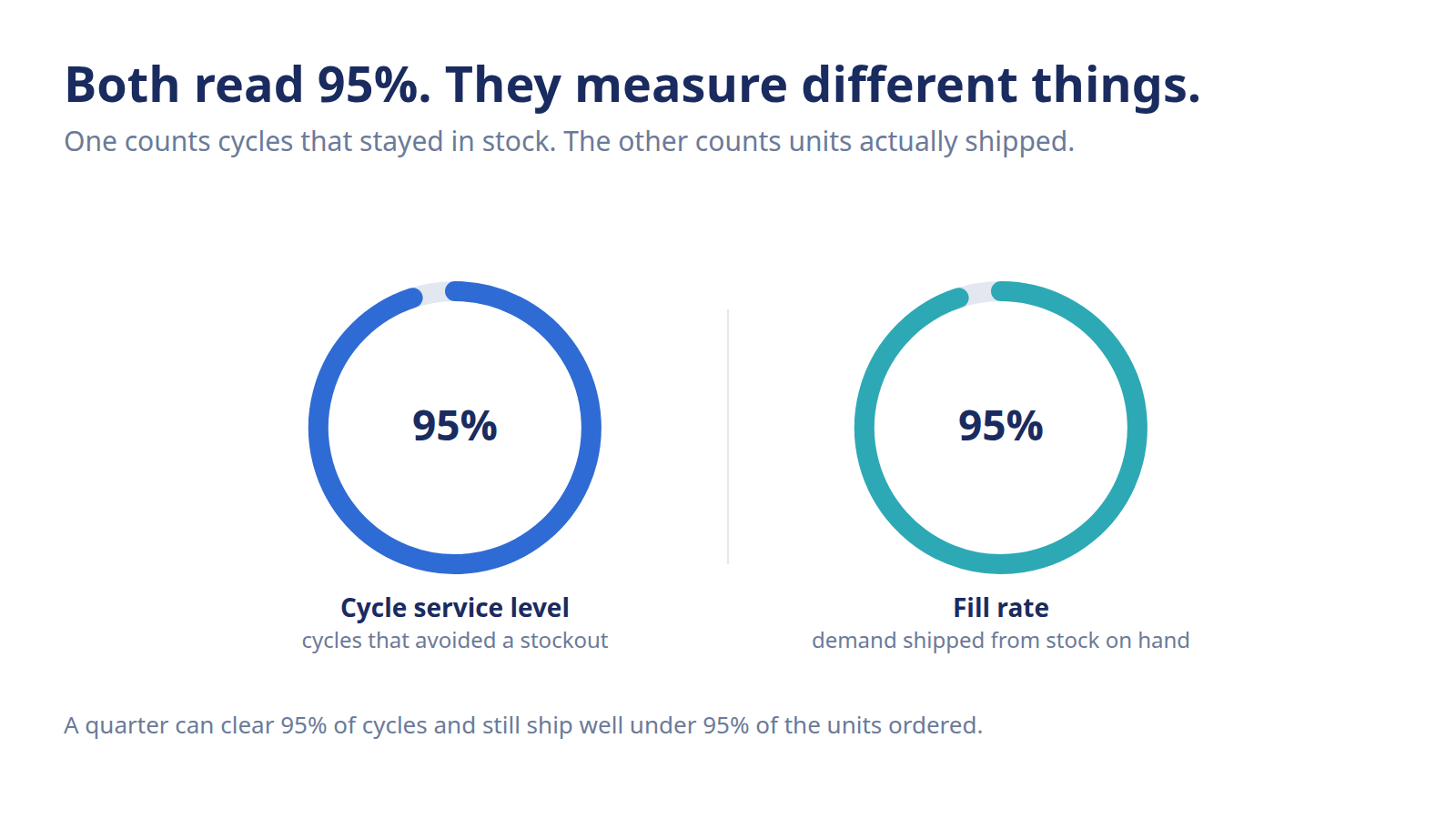
Service level and fill rate sound alike but differ. Learn cycle service level vs fill rate, how backorders hit each, and how they size safety stock.
"We hit 95% this quarter." Great, 95% of what, exactly? Ask two planners and you'll get two answers. One means the odds of not running out. The other means the share of demand actually shipped. Both call it "95%," and on your shelf they mean very different things. Confuse them and you'll green-light a service target that looks healthy while customers still hit "out of stock."
Service level and fill rate both measure how reliably you meet demand. Cycle service level, the precise name for "service level" on most dashboards, is the probability you don't stock out during a replenishment cycle. Fill rate is the percentage of demand you actually ship. A high service level can still sit next to a lower one.
What is service level?
Service level is the probability that you won't stock out during a single replenishment cycle. Say it's 95%: you expect to clear 95 out of 100 cycles without running dry, and accept a stockout in the other 5. It measures how *often* you stay in stock, not how much demand you cover when things go wrong.
That "how often, not how much" framing is the plain-English reason a strong service level can still sit next to a weaker fill rate.
Cycle service level, defined
When a spreadsheet or planning tool says "service level," it almost always means cycle service level, the probability of not stocking out between one replenishment and the next. Naming the precise term matters here. "Service level" is the phrase everyone searches and says out loud; "cycle service level" is what the number actually is. Same dial, one just tells you what it's measuring. And when you line it up against fill rate, the precise name earns its keep: cycle service level counts stockout *events* per cycle, while fill rate counts *demand* met.
It's a business dial, not a fixed target
Service level isn't a technical setting you solve for once, it's a business decision about how much stockout risk you'll wear. Push it toward 99% and you protect revenue on your best-sellers, but you tie up more cash in buffer stock. Dial it back to 90% on a slow mover and you free that cash for products that actually turn. That's why a single blanket target across the whole catalog quietly wastes money, set the dial by what each product is worth, which we get to below.
What is fill rate, and how is it different?
Fill rate is the percentage of demand you actually ship from stock, without a backorder or a lost sale. Where service level asks "did we run out this cycle?", fill rate asks "of everything customers wanted, how much did we ship on time?" It measures coverage, not events. That's why it can land lower than a healthy-looking service level.
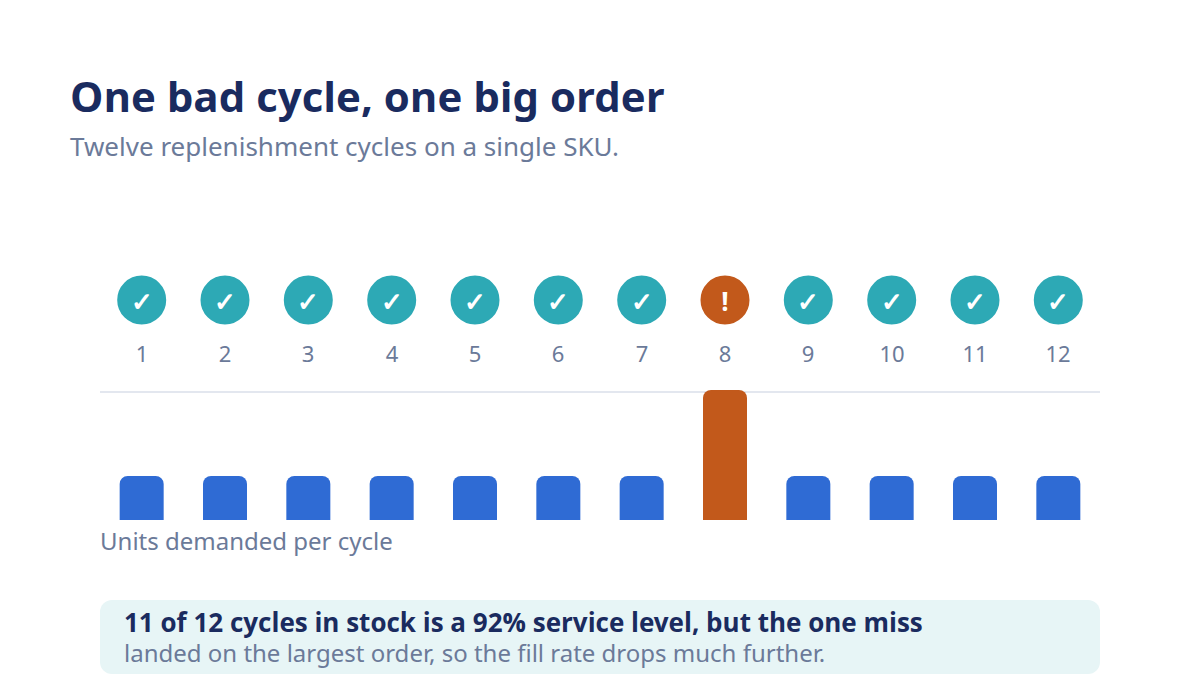
Here's the plain-English version of that gap. Say a SKU goes eleven cycles without a hiccup, then on cycle twelve it stocks out right as a wholesale order for 300 units lands. Your cycle service level is strong, you only missed one cycle in twelve. But fill rate takes it on the chin, because a single bad stockout swallowed a huge slice of demand at once. High service level, lower fill rate, same shelf. It cuts the other way too: frequent but tiny stockouts can dent service level while fill rate holds up. Read both, and you see the full picture.
Unit fill rate vs order fill rate
Fill rate comes in two flavors that answer different questions:
Unit fill rate: the share of demanded *units* shipped from stock. If customers wanted 1,000 units and you shipped 970, that's a 97% unit fill rate, the most common read for eCommerce.
Order fill rate: the share of *orders* filled completely, with nothing missing. One incomplete order counts as a miss even if you shipped nine of its ten lines. Stricter, and it matters more for wholesale and B2B, where a partial shipment is a partial failure.
Pick the one that matches how your customers feel a shortfall. A DTC shopper cares whether *their* item shipped; a retail buyer cares whether the *whole PO* landed.
Backorders and how they hit fill rate
A backorder is demand you couldn't ship now but promised to fulfill later, and how you count it changes the number. If a backorder eventually ships, some teams still score it against fill rate because it wasn't filled *on time*; others only count outright lost sales. Decide the rule up front and keep it consistent, or your fill rate drifts for no real reason. Backorders are where the two metrics split hardest: a backorder doesn't necessarily add a stockout *event*, but it absolutely subtracts from the demand you covered on time.
How does service level feed safety stock?
Your service-level target is the input that sizes your safety stock buffer. The higher the service level you choose, the bigger the Z-score it maps to, and the more buffer the formula tells you to hold. Service level is the business decision; safety stock is what it buys. You hold the buffer a 95% target requires, not the target itself.
The link to the buffer
Service level enters the safety stock calculation through the Z-score, a statistical multiplier that translates your chosen service level into a number the formula can use. A higher service-level target maps to a higher Z-score, which pulls the buffer up with it. That Z-score is the single place your service-level decision touches the math, and the full table of Z-values sits with the worked example below.
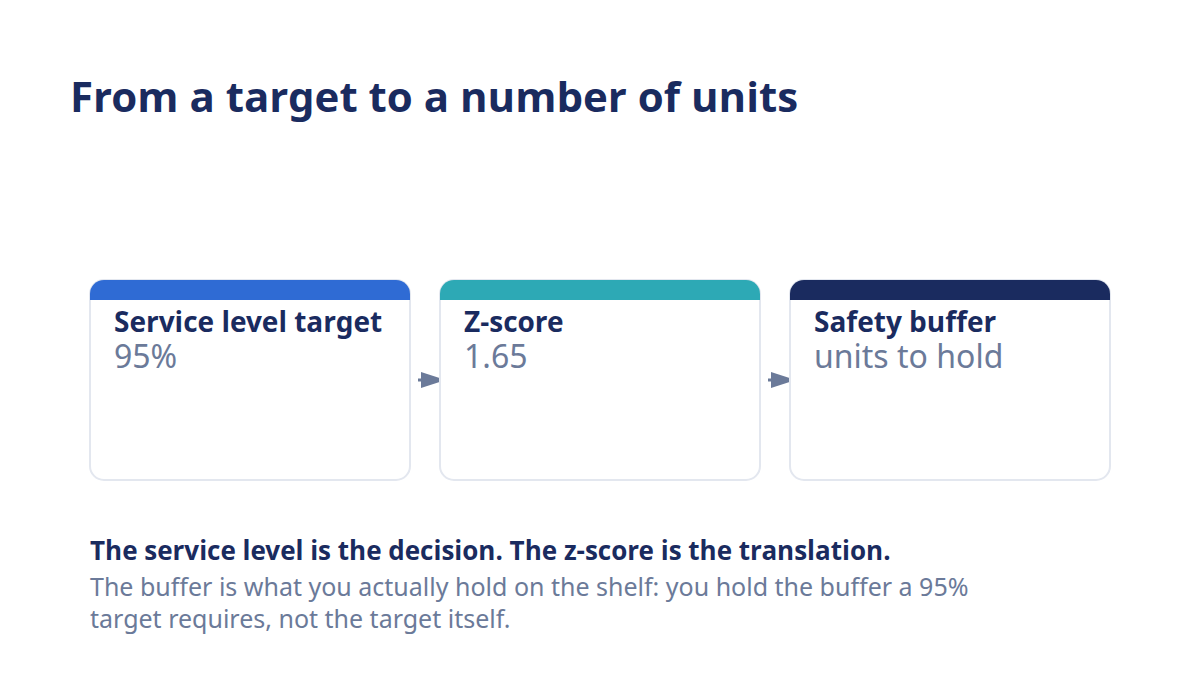
We won't re-run the calculation here, the full step-by-step lives in the safety stock formula worked example, which owns the Z-score table and the buffer math. For the concept behind the buffer itself, see what safety stock is. Just hold onto the chain: service level → Z-score → buffer size.
Choosing a target by SKU class
One service level for the whole catalog is the mistake that quietly burns cash. Your A-items, the vital few driving most of your revenue, earn a high target, because a stockout there costs real money. Your C-items can run leaner; over-buffering a slow mover just parks capital on a shelf.
The clean way to assign targets is by value tier, which is exactly what ABC analysis is built for. Rank your SKUs, give the A-class a 97-99% target, let the C-class sit at 90% or below, and you protect revenue where it counts without over-insuring the long tail. And because a stockout on a high-value SKU carries a real price tag, it's worth knowing the true cost of a stockout before you set that dial.
Setting that dial by hand across hundreds of SKUs is where most teams stall. Conative's AI-powered inventory planning tunes the service-level and safety-stock trade-off per SKU as demand shifts. You hold the right buffer on the products that earn it, instead of a blanket target that ties up cash across the catalog.
Frequently asked questions
Is service level the same as fill rate?
No. Service level (usually cycle service level) is the probability you don't stock out during a replenishment cycle, it counts stockout events. Fill rate is the percentage of demand you actually ship from stock, it counts units or orders covered. You can hit a high service level and a lower fill rate together, because one stockout can miss a lot of demand at once.
What's a good fill rate?
There's no universal number, but many eCommerce brands aim for a unit fill rate in the mid-to-high 90s on their core products. The right target depends on the SKU's value and how costly a shortfall is. Best-sellers justify a higher target; slow movers don't need one. Judge it against your own trend and your stockout cost, not a fixed benchmark.
What's the difference between unit and order fill rate?
Unit fill rate is the share of demanded units you ship from stock, 970 of 1,000 units is 97%. Order fill rate is the share of orders filled completely, so one missing line makes the whole order a miss. Unit fill rate suits DTC, where shoppers care about their item; order fill rate suits wholesale, where a partial PO is a partial failure.
How does a backorder affect fill rate?
A backorder is demand you ship late instead of on time. If you score fill rate on on-time fulfillment, a backorder counts as a miss even when it eventually ships. If you only count outright lost sales, it may not. Pick one rule and apply it consistently, or your fill rate moves for reasons unrelated to performance.
What service level should I target?
Set it by SKU value, not one blanket number. High-value A-items often justify a 97-99% target because a stockout there costs real revenue. Slow C-items can run at 90% or lower to free up cash. ABC analysis is the clean way to assign tiers, so you protect the products that matter without over-buffering the long tail.
Does a higher service level always mean more safety stock?
Yes, for the same SKU, a higher service level maps to a higher Z-score, which sizes a bigger safety stock buffer. Moving from 95% to 99% raises the buffer noticeably for a few points of added protection. That's the trade-off you weigh against carrying cost: more service level costs more cash held. The full math lives in the safety stock formula worked example.

.png)