Min/Max and Par Levels in Inventory Planning
Min/max and par levels set the floor and ceiling for each SKU. Learn how to set them, how min/max compares to reorder points, and which products fit best.
Not every SKU deserves a formula. Running a full reorder calc on the packing tape or the $4 refill isn't worth anyone's afternoon. Those items just need a floor and a ceiling, reorder when you drop below the floor, top back up to the ceiling, done. That's min/max, and it's the quiet workhorse most ops teams actually run. It trades a little precision for a lot of simplicity, and on stable, low-value stock, that's usually the right trade.
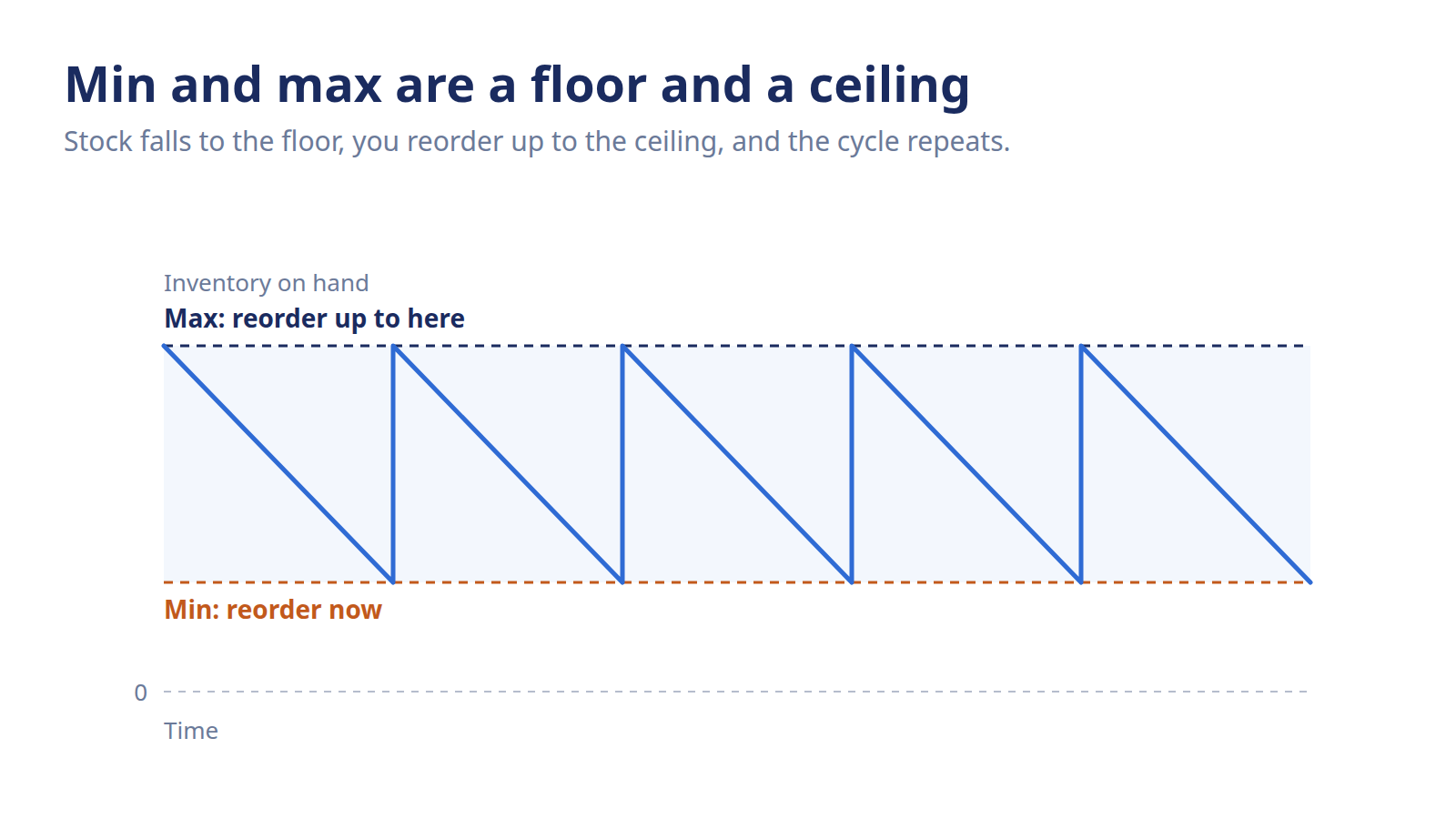
Min/max and par levels are simple stocking rules that set a floor and a ceiling for each SKU. The min is the level that triggers a reorder; the max is the level you reorder up to; a par level is a single target you top back up to each cycle. They're easy to run by hand.
What are min/max and par levels?
Min/max and par are the plain-English rules for keeping a SKU stocked without a spreadsheet full of math. Min/max uses two numbers: a floor that says "reorder now" and a ceiling that says "reorder up to here." Par collapses that into one target you replenish back to every cycle. Both answer the same question with different nuance.
Picture a bar restocking its liquor shelf. Nobody runs a demand model on the well vodka. They set a target, say, twelve bottles, and every week they buy back up to twelve. That target is the par level, the simplest stocking rule there is, and it works fine for steady, predictable movers.
Min (the trigger) and max (the cap)
Min/max gives you two dials instead of one. The min is your reorder trigger, when on-hand drops to it, you place an order. The max is the ceiling you refill to, which quietly sets your order size: whatever it takes to get from current stock back up to the max.
Min: the floor. Hit it, and you reorder. It covers demand during the lead-time wait plus a small buffer.
Max: the cap. It's how high you refill to, and the gap between min and max is your order quantity.
So min/max sizes the order for you. You don't calculate a separate quantity, you just buy the difference up to the max, and the rule does the arithmetic.
Par level (one number you replenish to)
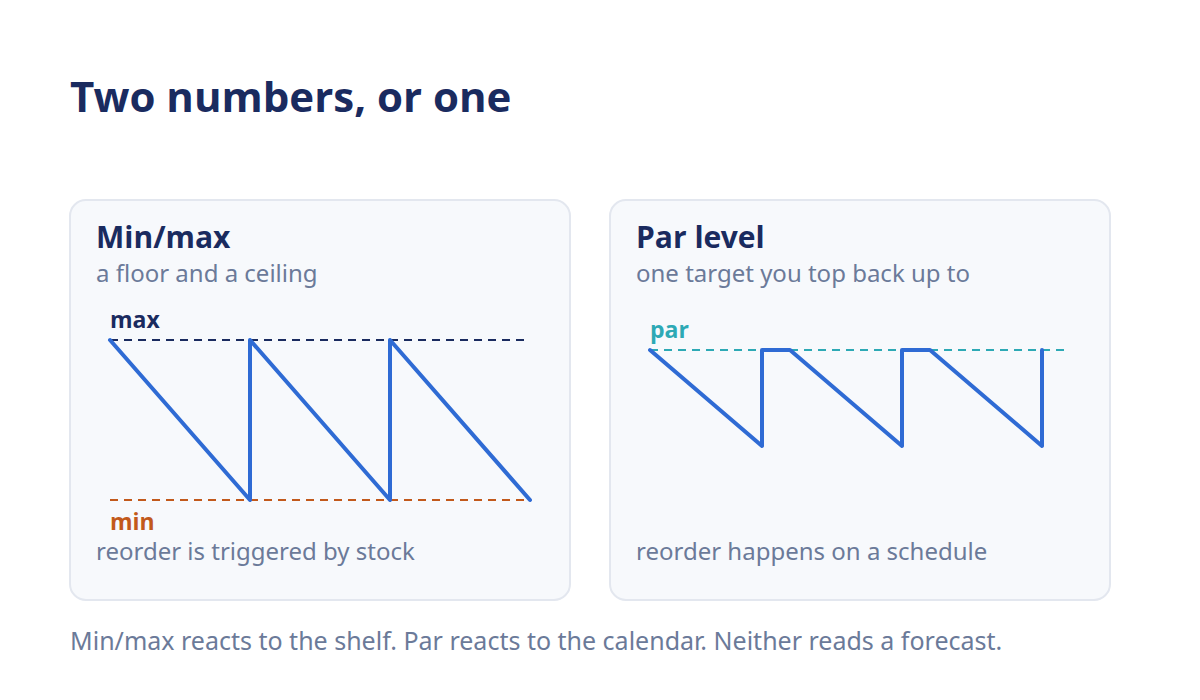
A par level is min/max with the two numbers folded into one. You set a single target and top back up to it on a fixed schedule, every week, every delivery day, whatever your cycle is. There's no waiting for a trigger. You count, you refill to par, you move on.
That's the trade-off. Par is dead simple but doesn't react to demand between counts. Min/max reacts the moment stock hits the floor, but you have to be watching. Par suits things you review on a rhythm; min/max suits things you'd rather have watch themselves.
How do you set min/max and par levels?
You set min/max by anchoring the floor to lead-time demand plus a small buffer, then setting the ceiling at that floor plus however much you want to order at once. A par level is simpler still: set it to the stock that carries you comfortably from one review to the next. The logic is light on purpose.
Setting the floor (min)
Your min should cover what you'll sell while you wait for the next order to land, plus a cushion for the days demand runs hot. So it leans on two things: how fast the product moves, and how long replenishment actually takes, the real door-to-shelf window, not the supplier's quote. If a SKU sells 10 a day and restocking takes 5 days, you'll burn roughly 50 units during the wait. So your floor sits above 50 with a little buffer on top.
That cushion is safety stock, and min/max borrows the idea without the full formula. For the concept behind the buffer, start with what safety stock is; for the actual math, the safety stock formula walks it end to end. Here, keep it lightweight, that's the spirit of a min/max rule.
Setting the ceiling (max)
The max is the min plus a sensible order quantity, enough that you're not reordering every other day, but not so much that cash sits on a shelf gathering dust. In practice, the gap between min and max maps to how you actually buy: a case, a pallet, a month's worth. Round to how the supplier ships and the rule gets easier to run.
Watch the ceiling, though. Set the max too high and min/max quietly turns into an overstock machine, because it refills to that number every time regardless of whether demand justifies it. The ceiling is where the method's coarseness bites, so give it a real think rather than padding it "to be safe."
Setting a par
A par level is one number: the stock that comfortably covers you from one review to the next, plus a small buffer. Review weekly and sell about 70 a week, and a par north of 70 keeps you clear until the next count. Shorter review cycles mean lower pars; longer cycles mean higher ones, since the stock has to stretch further between top-ups.
Here's a small "set the levels" table to make the three concrete. Numbers are illustrative, plug in your own demand and lead time.
- Packing tape: daily demand: 10/day; lead time: 5 days; min (floor): 60; max (ceiling): 180; par (weekly top-up): 90; logic: Floor = 5-day burn (50) + small buffer; ceiling adds ~a month's order; par tops up to ~1 week + buffer
- Gift box, small: daily demand: 20/day; lead time: 7 days; min (floor): 160; max (ceiling): 400; par (weekly top-up): 170; logic: Floor = 7-day burn (140) + buffer; wider min-to-max gap because it ships by the case
- Ribbon roll: daily demand: 5/day; lead time: 10 days; min (floor): 60; max (ceiling): 150; par (weekly top-up): 45; logic: Longer lead time lifts the floor; low, steady demand keeps the ceiling modest
Read it as a pattern, not a prescription. Faster movers and longer lead times push the floor up; how the supplier ships shapes the min-to-max gap; the par tracks your review rhythm.
Min/max vs the reorder-point method, which fits?
Min/max is simpler but coarser; the reorder-point method is more precise but needs more math. Min/max reorders up to a fixed ceiling, quick to run but blind to how demand shifts. A reorder point recalculates its trigger from current demand and lead time, tracking variability more tightly. The right choice comes down to how volatile and valuable the SKU is.
The comparison
Both methods fire a reorder when stock gets low, but they part ways on how the trigger gets set.
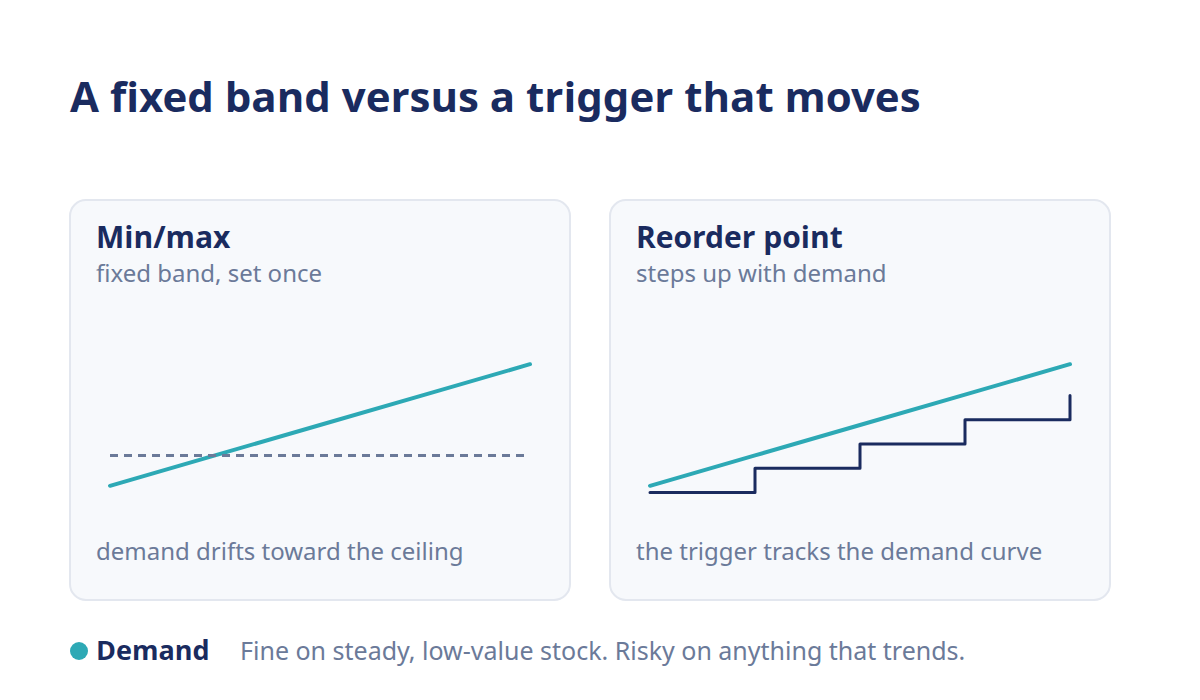
Min/max: fixed floor and ceiling. Fast to set, easy to run by hand, but the numbers sit still until someone changes them. Coarse by design.
Reorder point: a trigger built from lead-time demand plus safety stock, recalculated as inputs drift. More precise, more maintenance. For the full picture, see what a reorder point is.
Put plainly: min/max is a rule of thumb you can run on a clipboard; the reorder-point method is a calculation you keep current. One optimizes for effort, the other for accuracy.
Best-fit products
Match the method to the SKU. Stable, lower-value, predictable movers, the packing tape, the everyday refill, are perfect for min/max or par. The cost of being slightly off is small, and fine-tuning isn't worth the time. Volatile or high-value SKUs, where a stockout or overstock actually hurts, earn the tighter reorder-point method instead.
A common setup runs both across one catalog: min/max on the long tail of steady, cheap items, reorder points on the A-items that move the needle. Segmenting SKUs this way is what ABC analysis is for. For the full decision framework, periodic versus continuous review, method by product type, inventory replenishment methods lays out the whole comparison. This page owns the min/max and par how-to; that one owns the deeper method-selection call.
Where AI-powered levels help
The catch with min/max is right there in the definition: the levels sit still. Demand climbs, a lead time stretches, a product ages, and the floor and ceiling you set last quarter quietly go wrong. On a handful of SKUs you keep up by hand. Across hundreds, the levels drift out of date faster than anyone can retune them.
This is where AI-powered demand forecasting earns its place. Instead of fixed numbers you revisit once a quarter, the min and max recalculate as the model senses demand and lead time shifting. The levels stay current on their own. The payoff is time: Conative's inventory planning platform sets and updates min/max and reorder levels by SKU and flags when a product needs attention. So your team stops babysitting spreadsheets and gets hours back for the buying calls that need real judgment. The difference is that the levels move when demand moves, instead of holding last quarter's numbers until someone notices they are wrong.
Frequently asked questions
What's the difference between min/max and par?
Min/max uses two numbers, a min that triggers a reorder and a max you refill up to. Par uses one number: a single target you top back up to on a fixed schedule. Min/max reacts the moment stock hits the floor, while par replenishes on a rhythm regardless of when demand dips. Par is simpler; min/max is more responsive.
Is min the same as the reorder point?
They play the same role, both are the floor that triggers a reorder, but they're set differently. A min is often a fixed, hand-set number you leave in place. A reorder point is calculated from lead-time demand plus safety stock and recalculated as those inputs drift. Think of min as the simpler, coarser cousin of a reorder point.
How do you calculate a par level?
Set a par level to the stock that covers demand from one review to the next, plus a small buffer. Review weekly and sell about 70 units a week, and a par a bit above 70 keeps you clear until the next count. Shorter review cycles need lower pars; longer cycles need higher ones, since the stock stretches further between top-ups.
When should I use min/max instead of a reorder point?
Use min/max for stable, lower-value SKUs where being slightly off costs little and the time to fine-tune a formula isn't worth it. Reach for the reorder-point method on volatile or high-value items, where a stockout or overstock actually hurts and the tighter, recalculated trigger pays for the extra effort. Many teams run both across one catalog.
What products suit min/max best?
Min/max fits steady, predictable, lower-value movers, packaging, everyday refills, the long tail of items that sell at a consistent clip. These are the SKUs where a simple floor-and-ceiling rule is plenty and a full calculation is overkill. High-value or volatile products, where demand swings hard, are better served by a reorder point that tracks those swings more closely.
Can min/max levels update automatically?
Yes. AI-powered demand forecasting recalculates min and max levels as demand and lead time shift. The floor and ceiling update on their own instead of sitting frozen at last quarter's numbers. The benefit is practical: your team spends less time retuning levels by hand and more time on the buying decisions that need judgment.