Inventory Optimization: Where AI Actually Helps
Inventory optimization balances service and cost across your whole catalog at once. Learn what it is, how multi-echelon works, and where AI optimizes buys and buffers.
Setting one SKU's safety stock is easy. You pull the demand history, pick a service level, run the math, and you're done. Now do it for all 4,000 SKUs at once, against the same cash pile, the same warehouse space, and the same service promise. That's a different problem entirely, and it's the one inventory optimization is built for. It's less "what's the right number for this product" and more "what's the right set of numbers across the whole catalog."
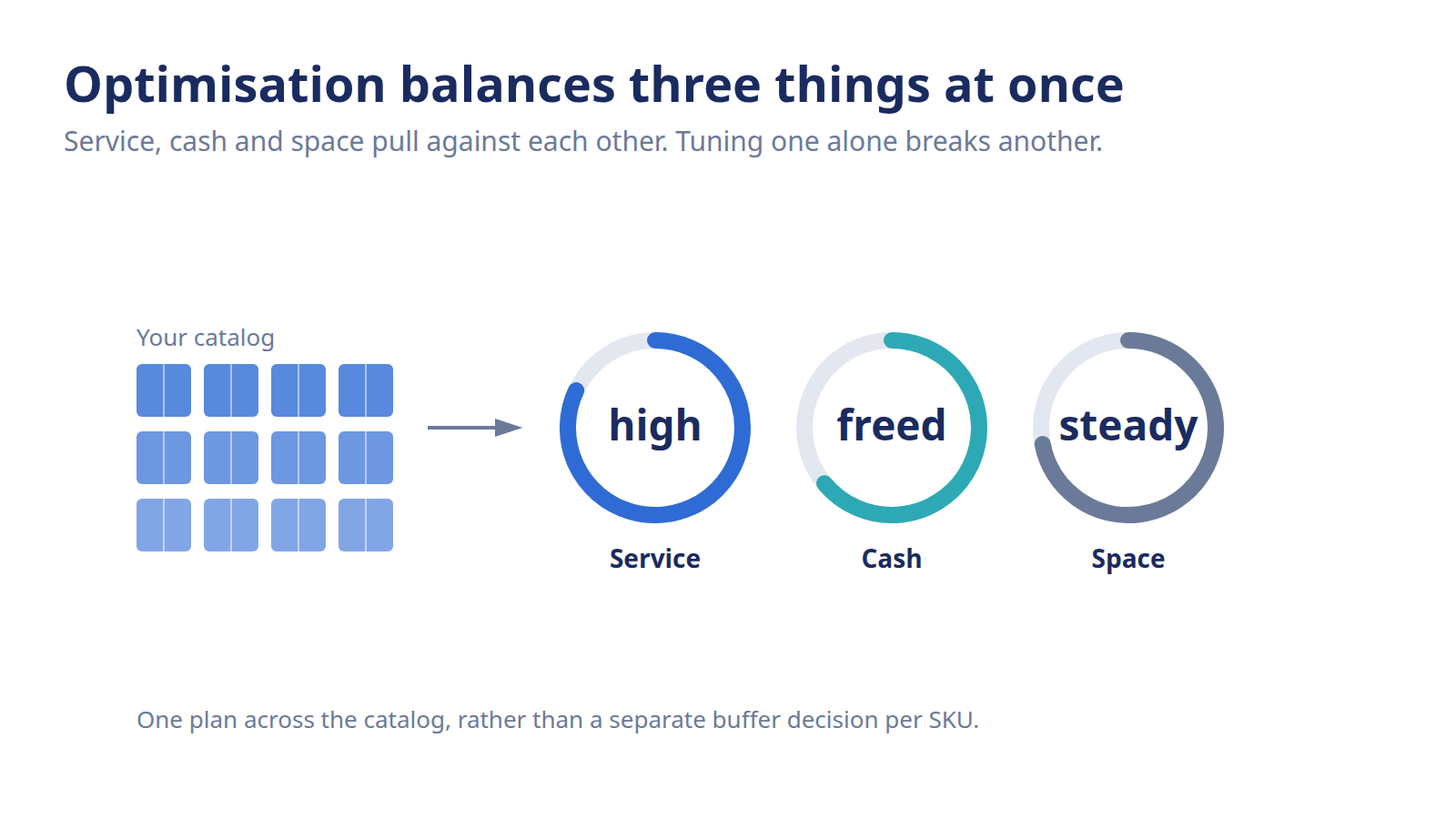
Inventory optimization is the practice of setting stock levels, buffers, and order sizes across your entire catalog to hit your service targets at the lowest total cost. Not one SKU at a time. It treats inventory as a system with trade-offs: service versus cash versus space. It's where AI-powered tools help most, since the math gets unwieldy by hand.
What is inventory optimization?
Inventory optimization is deciding how much of every product to hold, buffer, and reorder so your whole catalog hits its service targets at the lowest total cost. It treats inventory as one connected system, not a stack of separate SKUs. The aim isn't to perfect one product, it's the best outcome when everything competes for the same cash and space.
That "whole system" framing is the heart of it. You have a fixed budget and finite warehouse capacity. Every dollar you tie up in safety stock for a slow mover is a dollar you can't put behind a best-seller. Optimization allocates those constrained resources on purpose, instead of tuning each SKU in isolation and hoping the total adds up.
Optimization versus basic inventory planning
Basic inventory planning works one SKU at a time. You calculate a reorder point here, a safety stock buffer there, then move to the next product. It's the right place to start, and for a small catalog it's plenty.
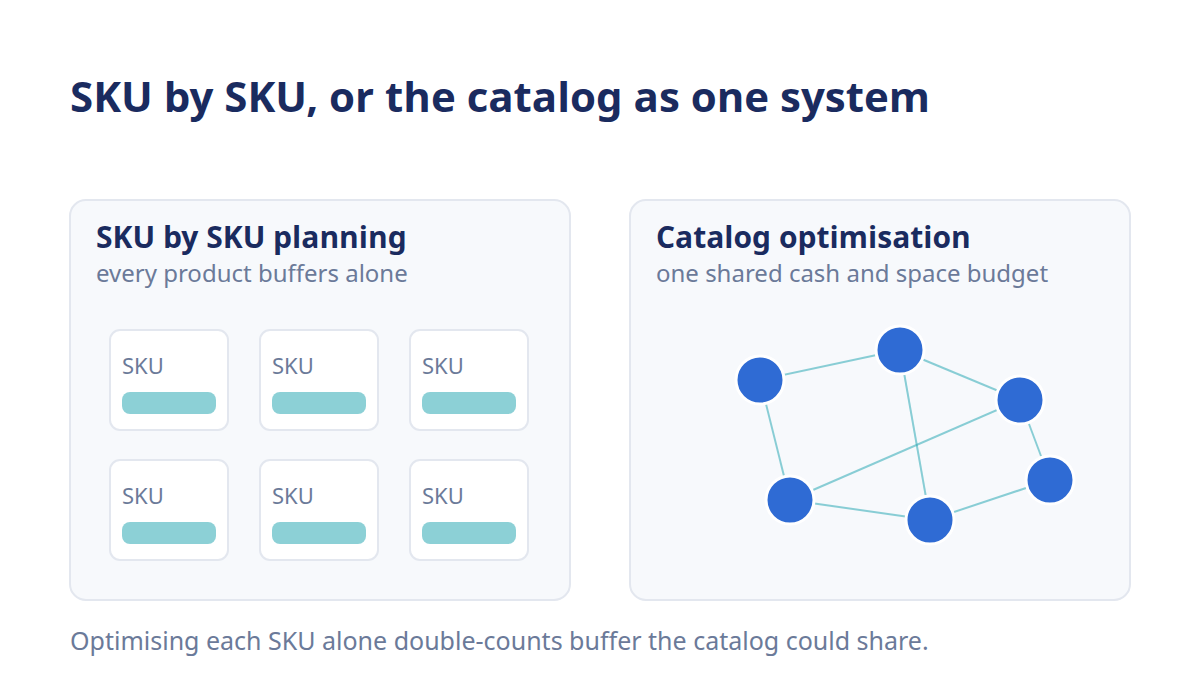
Optimization steps back and asks a bigger question: given everything you're carrying, what's the best allocation of cash and space across all of it? It uses the same building blocks, safety stock, reorder points, order quantities, but sets them together, with the trade-offs between SKUs baked in. Planning gets each product to a sensible number. Optimization gets the whole catalog to the best number it can afford.
The core trade-off: service, cash, and space
Every optimization decision lives inside a three-way tug-of-war. Push service level up and you carry more buffer, which ties up more cash and eats more space. Free up cash by trimming stock and you raise your stockout risk. No setting maxes out all three at once, that's why it's called optimization and not just "stocking up."
Service: how often you have the product when a customer wants it. Higher service needs more buffer.
Cash: the working capital frozen in inventory. Every extra unit is money you can't spend elsewhere.
Space: warehouse or 3PL capacity, which is finite and rarely free.
The job isn't to win all three. It's to protect service on the SKUs that matter while keeping cash and space under control everywhere else.
What is multi-echelon inventory optimization?
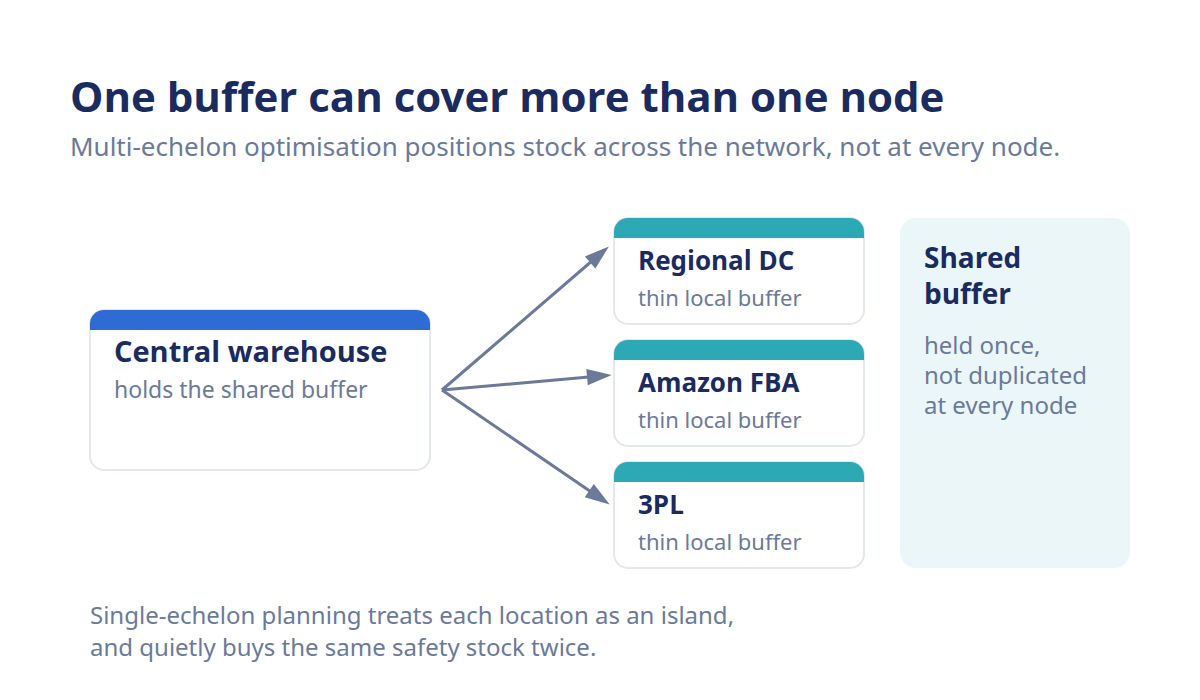
Multi-echelon inventory optimization (MEIO) means optimizing stock across every stage and location together, central warehouse, regional 3PLs, marketplace fulfillment, instead of each one on its own. A buffer held at one location can cover risk for another, so you position stock across the network as a whole rather than over-buffering every node.
Single-echelon optimization treats each location as its own island: set the right stock for the warehouse, then for each 3PL, done. The trouble is it quietly double-counts safety stock. Every location holds its own buffer for the same demand swings, and the total balloons. Multi-echelon looks at the network as one system and asks where a unit of buffer does the most good, which usually means holding less in more places.
Why DTC brands run into this sooner than they expect
You might assume multi-echelon is an enterprise-only concern. It isn't anymore. The moment a growing eCommerce brand splits inventory across a home warehouse, a couple of 3PLs, and Amazon FBA, it's running a multi-echelon network whether it planned to or not. Each node holds its own buffer, and without a network view, the same demand variability gets padded two or three times over. That's cash sitting idle in redundant safety stock, a common, expensive blind spot for growing brands scaling their fulfillment footprint.
How does AI help optimize inventory?
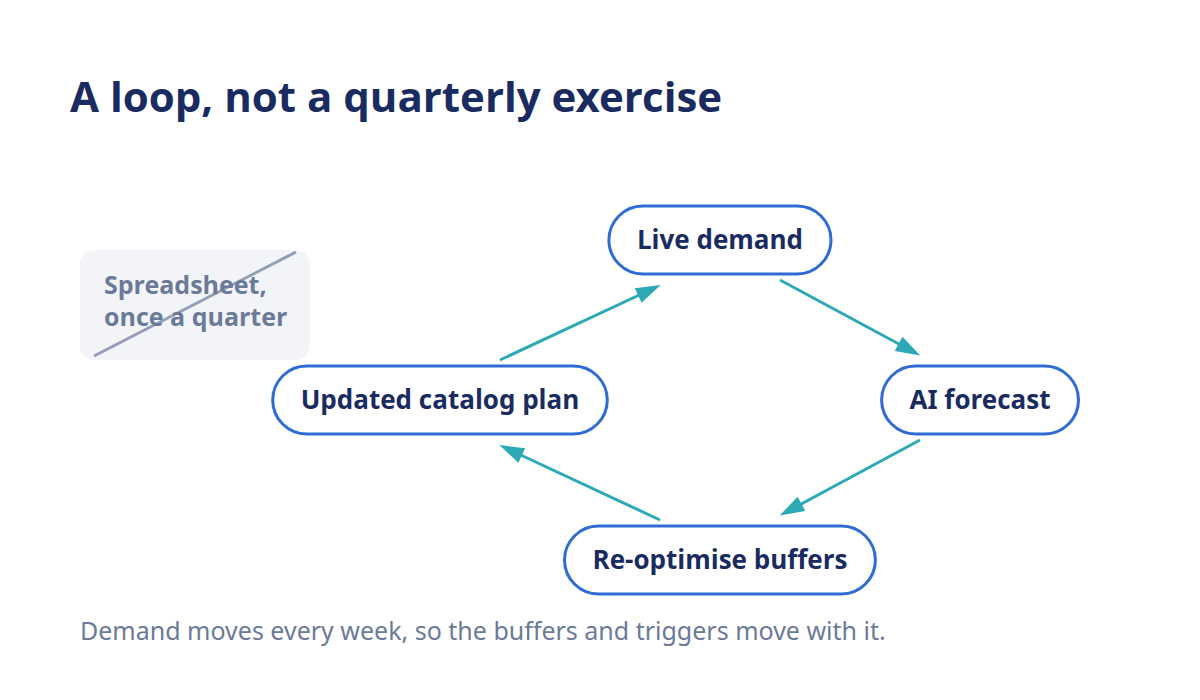
AI re-optimizes stock levels, buffers, and order sizes across your catalog as the data changes. Instead of a static plan you rebuild each quarter, AI-powered tools recompute the trade-offs continuously, so your numbers keep pace with real demand. The payoff: less time in Excel, fewer stockouts and less overstock.
The math itself isn't the hard part. Setting the right buffer for one SKU is a formula you can run by hand. The hard part is scale and change: thousands of SKUs, each with shifting demand, spread across locations, all pulling on the same cash. Re-solving that by hand every time demand moves isn't realistic, which is where the automation earns its place.
AI on safety stock and reorder optimization
Left alone, a safety stock number set in January is running on January's demand by March. AI-powered forecasting feeds current demand and variability back into the buffer and reorder math, so the numbers refresh as patterns shift rather than drifting stale. It doesn't change the logic of the safety stock formula or the reorder point. It keeps the inputs live and re-runs them across the whole catalog at once, the part no planner has time to do by hand.
The so-what: what you actually get
Faster, more frequent optimization tends to show up in two places for the operator. First, time: planners stop rebuilding buffer calculations by hand and get hours back each week. Second, working capital: catalog-wide tuning squeezes out the redundant overstock that piles up when every SKU is padded in isolation. Both effects come from the same shift, tuning the catalog as one system instead of one SKU at a time.
This is where optimization connects to the wider system. Getting your buys and buffers right is one half; keeping supply and demand in the right balance is the other. And it runs smoother when the reordering itself is automated, the territory of automated inventory management, where optimized numbers become actual purchase orders without manual re-keying. Conative's inventory planning platform sets safety stock, reorder points, and order sizes across your catalog from a live forecast, so the optimization and the execution stay in step. Want to see it run on your own SKUs? Book a demo and we'll walk your catalog through it.
Frequently asked questions
Is inventory optimization the same as inventory planning?
Not quite. Inventory planning sets sensible stock levels one SKU at a time, a reorder point here, a safety stock buffer there. Inventory optimization steps back and sets those numbers across the whole catalog together, balancing service, cash, and space as one system. Planning gets each product to a good number; optimization gets the whole catalog to the best number your budget and space allow.
What is multi-echelon inventory optimization?
Multi-echelon inventory optimization (MEIO) means optimizing stock across every location and stage of your supply chain together, rather than one at a time. Because a buffer at one node can cover risk for another, it positions stock across the whole network instead of padding every location separately. That avoids double-counting safety stock, which is where single-location planning quietly over-buys and ties up cash.
Does inventory optimization need AI?
No, but AI makes it practical at scale. You can optimize a small catalog by hand or in a spreadsheet. Once you're balancing thousands of SKUs with shifting demand across several locations, re-solving the trade-offs manually every time demand moves isn't realistic. AI-powered tools recompute stock levels and buffers continuously, so your numbers keep pace with demand instead of going stale between quarterly reviews.
How is optimization different from setting a reorder point?
A reorder point answers one question for one product: at what stock level should you reorder it. Optimization uses reorder points as building blocks but sets them across the entire catalog with the trade-offs between SKUs built in. One reorder point is a single decision in isolation; optimization is the allocation of limited cash and space across every decision at once.
Can small brands do inventory optimization?
Yes. Small brands optimize informally all the time, deciding to hold more of a best-seller and less of a slow mover is optimization in miniature. The formal, catalog-wide version becomes worth it as your SKU count grows and inventory ties up more cash. The moment you split stock across multiple locations or 3PLs, a network-level view starts paying for itself.
What does AI optimize that a spreadsheet can't?
Scale and freshness. A spreadsheet can hold the formulas, but it can't re-run them across thousands of SKUs every time demand shifts, and its numbers go stale the moment sales history updates. AI-powered forecasting keeps the demand inputs live and re-optimizes buffers, reorder points, and order sizes continuously across the whole catalog, so the plan reflects current demand rather than last quarter's snapshot.