New Product Forecasting Without Historical Data

With no sales history, new-product forecasting relies on analog, judgmental, and market-test methods. Compare the three and learn which to use for which launch.
Everyone has an opinion on how the new SKU will sell. The founder feels a hit, the buyer remembers the last miss, marketing has a spreadsheet of maybes. But "everyone's opinion" isn't a method, and the buy is real money. There are three actual methods for forecasting without history, and each earns its keep on a different kind of launch.
The main methods for forecasting a new product without history are analog forecasting (model it on a similar past SKU), judgmental forecasting (structured expert estimates), and market testing (a soft launch that generates real demand data). Each fits a different launch: analog for line extensions, judgment for novel items, market testing when the stakes justify the wait.
Key takeaways
- "Everyone's opinion" is not a method: there are three real ones, and the choice follows how novel the product is and how big the buy is.
- Analog is the default where a comparable exists: it grounds the forecast in how your customers actually behaved, not in anyone's optimism.
- Judgment works only with structure: independent estimates first, ranges instead of points, assumptions in writing.
- A market test buys certainty with time: real purchase data for the real product, at the cost of momentum and test stock.
Analog forecasting: borrow the launch curve you already own
Analog forecasting borrows the launch curve of a similar existing product as the baseline for the new one, then adjusts for the differences. It's the default method wherever a credible comparable exists, because it grounds the forecast in how your actual customers actually behaved, rather than in anyone's optimism. The quality of the forecast is the quality of the match: price point, category, audience, and launch push all have to rhyme.
Best for line extensions
Analog forecasting shines when the new product is a variation of something you already sell: a new colorway, the next scent, a seasonal edition of a proven design. The analog is obvious and recent, the adjustments are small, and the error band tightens accordingly. The further the new product strays from anything in the catalog, the weaker the method gets, which is exactly where the other two come in. (The full working of the method, from picking the analog to the adjustment math, is owned by the step-by-step guide.)
What is judgmental forecasting and when is it reliable?
Judgmental forecasting builds the number from structured human estimates: your team, sometimes suppliers or retail partners, each forecasting independently before comparing. It's the method of last resort by reputation and the method of first resort in practice, because every new-product forecast contains judgment somewhere. The difference between judgment as a method and judgment as a guess is structure: multiple independent inputs, ranges instead of points, and written assumptions someone can challenge.
Reducing bias
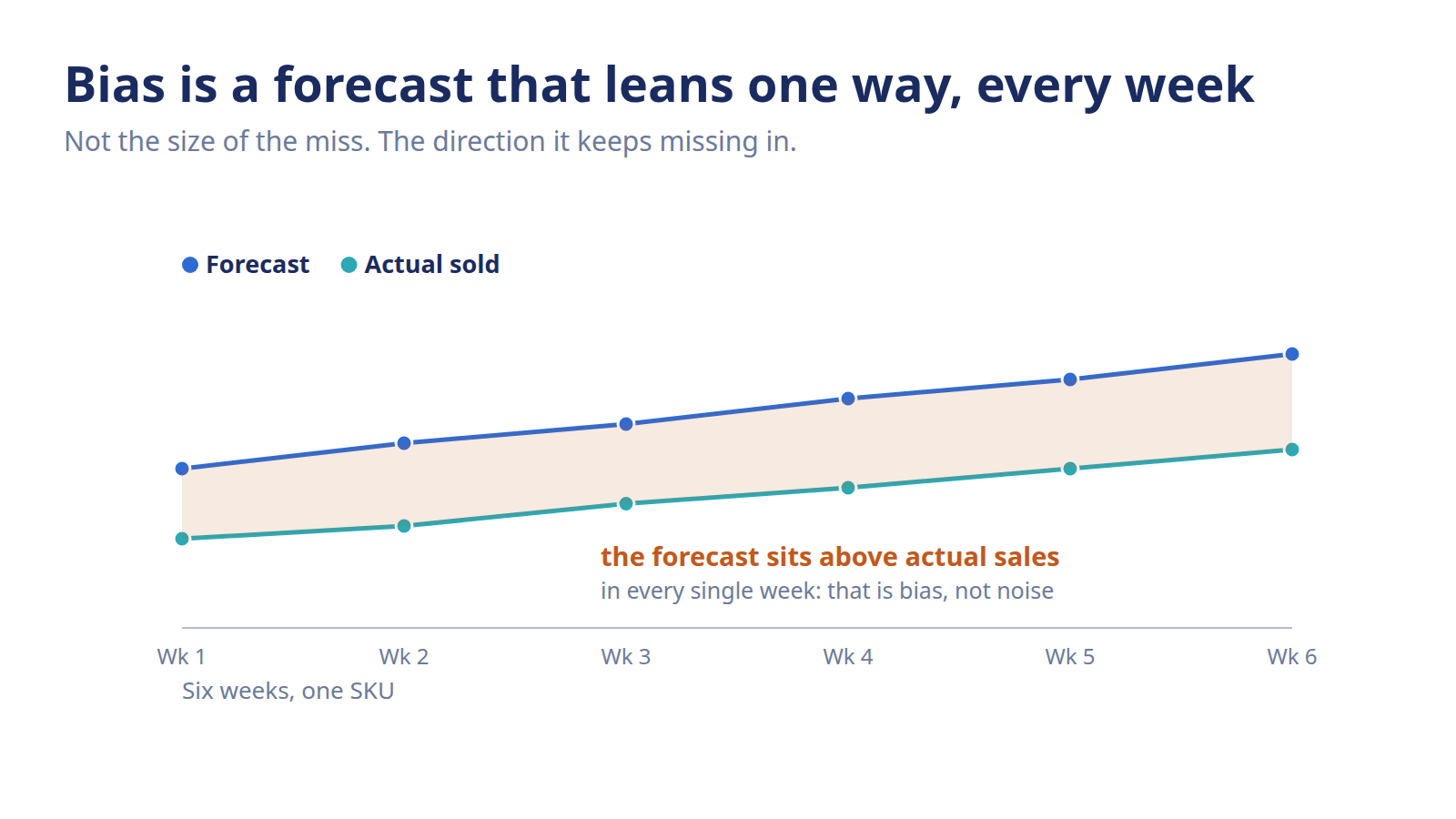
Unstructured judgment fails in predictable ways: optimism from whoever championed the product, anchoring on the first number said aloud, and confidence that grows with seniority rather than accuracy. The countermeasures are cheap:
- Collect estimates independently before anyone shares theirs. The first number spoken aloud anchors every number after it.
- Ask for a low, likely, and high rather than one figure. Ranges force people to admit what they don't know.
- Write down each estimate's key assumption, so a wrong forecast teaches you which assumption broke.
- Score the forecasters over time: record estimates against actuals, so the next launch knows whose judgment runs hot and whose runs cold.
Formal versions of this exist (the Delphi method runs anonymous estimation rounds until they converge), but the lightweight version captures most of the value.
What is market testing for new products?
A market test generates real demand data before the full buy: a soft launch to part of your list, a limited drop, a regional release, or a pre-sale. Instead of predicting demand, you sample it. It's the only method that produces actual customer behavior for this actual product, which makes it the most trustworthy signal available and the most expensive: it costs time, a slice of launch momentum, and enough test inventory to read a result.
When the wait is worth it
Test when the buy is large relative to your cash, when the product is genuinely novel, or when the downside of a miss is a season of dead stock. Skip the test when speed is the whole game (a trend item whose window won't survive a six-week test) or when the buy is small enough that the reorder is the test. A pre-sale is the special case that pays twice: it tests demand and finances the buy with committed orders.
Which method should you use?
Match the method to how novel the product is and how big the buy is. Close comparable in the catalog: analog. No comparable but deep team experience: structured judgment. Big bet, novel product, patient timeline: market test. In practice mature brands blend all three, using an analog baseline, judgment for the adjustments, and a pre-sale where the stakes warrant it.
- Analog. how it works: Borrow a similar SKU's launch curve, adjust for differences; best for: Line extensions, variants of proven sellers; limitation: Only as good as the match
- Judgmental. how it works: Structured independent estimates, ranges, written assumptions; best for: Novel items, thin catalogs, fast decisions; limitation: Bias creeps in without discipline
- Market test. how it works: Soft launch or pre-sale generates real demand data; best for: Large buys, genuinely new products; limitation: Costs time, momentum, and test stock

Whichever method builds the number, the follow-through is the same: hold it as a range, order against the conservative end where reorders are possible, and correct fast once real sales exist. That correction loop is where AI-powered demand forecasting quietly outworks any manual method. Conative AI re-forecasts a launch continuously from day one, blending the pre-launch baseline with live sales as they arrive, so the forecast a week after launch already reflects reality instead of waiting for next month's planning cycle. The method gets you to launch day; the model takes it from there. See a demo. (Turning the forecast into an order quantity is its own decision, owned by planning inventory for a product launch.)
Frequently asked questions
What's the most accurate new-product forecasting method?
Market testing, when you can afford it, because it measures real purchases of the real product instead of predicting them. Analog forecasting is the strongest predictive method where a close comparable exists. Structured judgment is the most fallible but the most available. Most accurate in practice: an analog baseline, judgment adjustments, and a fast post-launch correction.
Can you combine analog and judgmental forecasting?
Yes, and the combination is the standard playbook. The analog supplies an evidence-based baseline curve; judgment supplies the adjustments the data can't see, like a stronger launch plan or a shifting trend. Keep the two visible separately (baseline plus named adjustment factors) so you can audit later which part of the forecast was wrong.
What is the Delphi method for new products?
Delphi is a structured judgmental technique: a panel forecasts independently and anonymously, sees the group's summarized results, then re-estimates over several rounds until the numbers converge. Anonymity blunts seniority bias and anchoring. Few brands run formal Delphi for a product launch, but its core moves (independent estimates first, ranges, iteration) are worth stealing.
How big should a market test be?
Big enough to read a signal, small enough that a failure is cheap. In eCommerce that's typically a limited drop or a pre-sale to a defined slice of your audience, with a decision rule written before launch: what sell-through, over what window, triggers the full buy. Without the pre-agreed rule, any result gets argued into "promising."
Does AI help forecast products with no history?
Yes. AI-powered platforms automate the analog approach as look-alike modeling: matching the new product to similar items in your catalog by price, category, and audience, building the baseline from their launch curves, then correcting it with live sales from day one. That gives a launch an evidence-based starting forecast instead of a blank cell.
How do you forecast a product that's first of its kind?
With no analog anywhere, triangulate three weak signals into one honest range: structured judgment with written assumptions, external reference launches from adjacent markets, and demand evidence you can create cheaply (a waitlist, a pre-sale, a limited drop). Order to the conservative end with a fast reorder path, and let the launch itself become the data.