What Is the Demand Planning Process (Step by Step)?
The demand planning process runs in four stages: gather data, build a statistical forecast, reach consensus, then review. Here's each step explained.
New to demand planning and not sure what the actual job looks like month to month? Job descriptions describe the outcome and skip the work. The work is a loop, the same four moves repeating on a cycle, and once you can see the loop the role stops feeling like guesswork.
The demand planning process is a repeating cycle with four stages: gather and clean data, generate a statistical forecast, reach consensus across teams, then review accuracy and adjust. Most eCommerce brands run it monthly. Done well, it turns scattered inputs into one agreed demand plan everyone buys and markets against.
Key takeaways
- The output is agreement, not a number: a forecast nobody signed up to is a spreadsheet, and it will be overridden the first time it is inconvenient.
- It runs as a loop, not a project: four stages repeating on a set cycle, usually monthly for an eCommerce brand.
- Cadence follows your buying rhythm: if you place orders monthly, planning monthly keeps the plan in step with the decisions it feeds.
- Consensus is the stage teams skip: it is also the one that determines whether the other three were worth doing.
What are the stages of the demand planning process?
Four steps, in order: data, forecast, consensus, review. Each stage has a defined input, a defined output, and someone accountable for it, which is what separates a process from a habit. Skip one and the next inherits the gap. The most common failure is running stages one and two well, producing a technically sound forecast, and then treating three and four as optional, which is how brands end up with an accurate forecast nobody uses.
- 1. Gather and clean data. input: Sales history, stock records, promo calendar; output: One trusted dataset; typically owned by: Planner or analyst
- 2. Build the statistical forecast. input: The clean dataset; output: A baseline demand number per SKU; typically owned by: Planner
- 3. Reach consensus. input: The baseline plus commercial context; output: One agreed plan; typically owned by: Cross-functional, planner facilitates
- 4. Review and adjust. input: Last cycle's plan versus actual sales; output: Corrections and a cleaner next cycle; typically owned by: Planner
Step 1: gather and clean data
Everything downstream inherits the quality of this stage, which is why experienced planners spend more time here than newcomers expect. You are pulling sales history per SKU, current and historical stock positions, the promotional calendar, and lead times, then reconciling them so they describe the same reality. The reconciliation is the real work. Duplicate SKU records, returns booked in the wrong period, and stockout weeks recorded as low demand all quietly distort the forecast that follows. Marking the stockout weeks matters most, because uncorrected they teach every subsequent model to under-forecast exactly the products that sell out.
Step 2: build the statistical forecast
With clean data, you produce a baseline: a demand number per SKU for the horizon you buy against. This stage is arithmetic rather than opinion, and it should stay that way. The method can be a moving average, an exponential smoothing model, or a learned model reading a wider signal set, but whichever you choose, the output is what the data says before anyone argues with it. Keeping the baseline unedited is a discipline worth defending, because it gives you something to compare the final agreed plan against, and that gap is the most useful diagnostic you will get. For the mechanics of building the model itself, see how to build a demand forecasting model.
Step 3: reach consensus
Now the baseline meets the things the data cannot know. Marketing has a campaign booked that has no historical equivalent. Sales has a wholesale order that has not landed in the system. Finance has a budget the plan needs to respect. Consensus is the stage where those overlays get applied deliberately, in one conversation, with someone recording what was changed and why. That record is what turns an override into information: next cycle you can see whether the adjustment helped. Who convenes this meeting and who owns the resulting number is a question worth settling explicitly, covered in what demand planning is and who owns it, and the broader executive version of the same cycle is S&OP.
Step 4: review and adjust
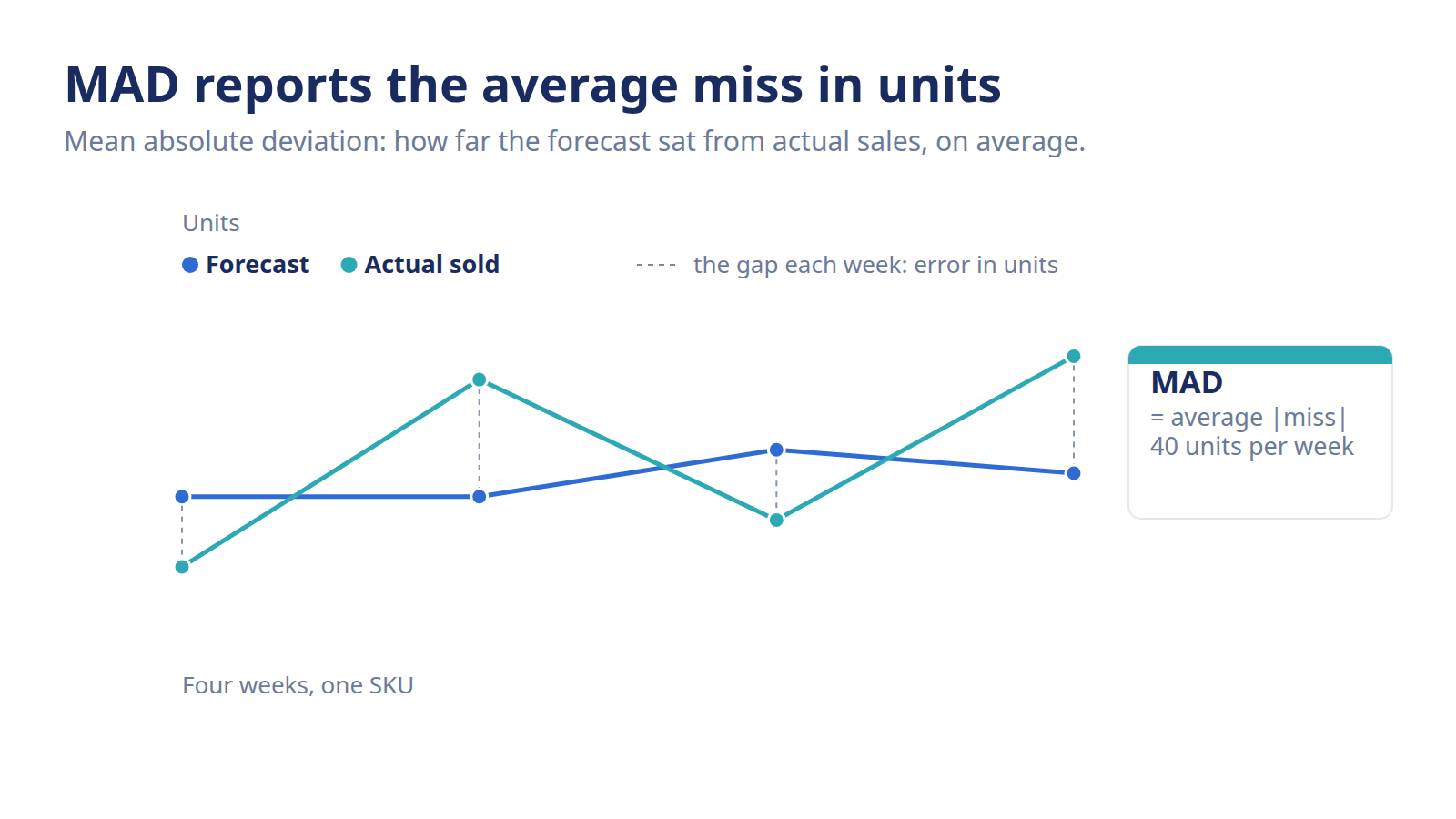
The last stage closes the loop by grading the previous one. You compare what the plan said against what actually sold, per SKU, and look at two things: how large the misses were and whether they leaned consistently in one direction. Size tells you how much slack to carry. Direction tells you something is structurally wrong, an optimistic override applied every month, a seasonal shape that no longer matches. Most teams check size and ignore direction, which is why the same bias survives for years. What you learn here feeds straight back into stage one, and the cycle starts again with better inputs than it had last month.
How often should you run the demand planning process?
Match the cycle to how often you buy. Monthly works for most eCommerce brands, because it lines up with the rhythm at which purchase orders are actually placed and gives each cycle enough new sales data to say something. Run it weekly and you spend more time planning than acting, with most cycles producing changes too small to justify the meeting. Run it quarterly and the plan is describing history by the middle of the period.
There are honest exceptions. Brands with very short lead times and fast-moving categories often go fortnightly. Brands buying seasonally from overseas suppliers may plan monthly but make the buying decisions on a longer arc. The test is not what a textbook recommends, it is whether a cycle produces decisions. If a planning meeting routinely ends with nothing changing, the cadence is too tight. If decisions get made outside the cycle because waiting for it would be too slow, the cadence is too loose.
What makes the process actually work?
A plan no one agrees to is just a spreadsheet. Consensus is the part teams skip and regret. The stages are easy to write down and easy to run mechanically; what separates a process that changes decisions from one that produces documents is whether the output has authority. That authority comes from three things, none of them technical: a named owner for the number, a standing slot in the calendar that does not get cancelled, and a written record of what was overridden and why.
The second thing that makes it work is honesty in stage four. A review that celebrates the good SKUs and skips the bad ones is not a review. The value is concentrated in the misses, particularly the repeated ones, because those are the only ones you can systematically fix. Teams that publish their forecast error and act on the pattern improve; teams that only report the plan do not. The practices that separate the two are collected in demand planning best practices.
This is also where the routine work is worth handing off. Conative AI's Analyst Agent covers forecast analysis, anomaly detection, and performance monitoring, so the stage-four review starts from a list of what actually moved rather than a blank comparison someone has to build. It works autonomously on the analysis and stops there: it does not change your plan or place an order, so the consensus and the decisions stay with your team. See how it fits the cycle on the inventory planning platform.
Frequently asked questions
Who is involved in the demand planning process?
A planner runs the cycle, and consensus needs whoever holds information the data lacks: marketing for campaigns, sales for wholesale commitments, finance for budget constraints, and operations for supply reality. In a small brand these may be three people wearing five hats. The roles matter more than the headcount.
How long does one demand planning cycle take?
The active work is usually a few days spread across the month rather than a solid block: data preparation early, forecast generation next, a consensus meeting of thirty to ninety minutes, then a review at the close. Brands starting out often spend far longer on data preparation than on everything else combined.
What's the output of the demand planning process?
One agreed demand number per SKU for the planning horizon, with the assumptions and overrides behind it recorded. That number then drives purchasing, capacity, and cash planning. If your process ends with several competing numbers in different spreadsheets, the consensus stage did not actually happen.
What tools support the demand planning process?
At minimum a reliable sales export and a spreadsheet. Beyond a few hundred SKUs, most brands move to a planning platform for the forecast and the accuracy review, keeping the consensus conversation human. The tooling matters less than whether the cycle runs on schedule.
How is the demand planning process different from forecasting?
Forecasting is one stage inside the process. The process wraps the forecast in data preparation before it and consensus plus review after it. A brand can forecast well and still plan badly, if nobody agrees to the number or nobody checks it afterwards.
What goes wrong most often in demand planning?
Consensus gets skipped because the meeting is hard to schedule, so the plan has no authority and gets overridden ad hoc. A close second is a review stage that measures the size of errors but never their direction, which lets the same bias run for years unnoticed.